

How an LGM Collection Is Born: The Creative Process at La Gallina Matta
We’re often asked how a La Gallina Matta product comes to life. The truth is there’s no precise formula, no single fixed path. Every collection takes shape from an intuition, a fragment noticed almost by chance, a journey, a detail spotted while crossing a street, an image that stayed in memory—or something that, in an instant, stops being what it was and becomes something else.
It starts there: from an idea that doesn’t yet have defined contours, but already carries a direction within it. Then the search begins. For lines, balance, flavor. For that feeling the drawing must return once it becomes an object. It’s a delicate phase, built on listening and focus, because it’s not just about imagining a decorative motif, but about intuiting its identity, its character, its place within the LGM universe.

The creative idea behind every LGM collection
Every collection begins with a creative gesture from the founder and creative director Claudia, who identifies a theme and develops it into a decoration, a form, a narrative detail. Inspiration can come from anything: a trip, a museum, a conversation, a film, a landscape—or an everyday fragment that suddenly sparks something.
In this phase everything is still open. The idea moves between memory and imagination, observation and desire—and it’s precisely in that indeterminacy that it finds its strength. There’s no linear path, but a series of rejections, attempts, associations that slowly lead to the first mark.
From suggestion to the first sketch
The first sketch is often where the intuition begins to take shape. It can start on paper, on a napkin, or directly on the computer. It’s still an instinctive, almost private step—one that only someone close to the creative process can truly read. But in that initial stroke, everything is already there: the idea of movement, the search for a certain lightness, the desire to give a mark a precise function and presence.
Drawing and product development
From the sketch you move to the actual drawing. It’s a long phase, made of hours at the computer, progressive refinements, tiny but decisive corrections. The drawing is cleaned, rethought, made more readable, more coherent, better suited to become embroidery. Here technical precision and aesthetic sensitivity come into play, because the file must deliver exactly the desired effect: lightness, depth, movement, essentiality, or decorative richness.
This is one of the most delicate moments: the drawing must not only be beautiful to see, it must also work in its future material translation. It must therefore dialogue with the technical limits of production without losing its original identity.

From the creative file to the technical file
Once defined, the drawing is converted into a vector file and then adapted to a technical program where all the elements needed for tailoring are set. It’s a highly specialized phase that demands precision, patience, and continuous checks.
Here the creative mark meets the machine, but not in a cold or automatic way. On the contrary, the technical file is the bridge between the idea and the final product: it must be clear, clean, and correct, because it will guide the embroidery execution. Every detail matters, and often it’s the micro-corrections that determine the overall quality of the result.
Choosing colors and yarns
When the file is ready, the collection moves to tailoring for the first sample. This is where the collection truly begins to come to life. At this stage, the colors of the yarns are chosen—always in coherence with the original idea and the atmosphere you want to achieve.
Color choice is never an accessory: it’s a substantial part of the project. Colors define the collection’s tone, its emotional temperature, the way the drawing will be perceived once applied to fabric. For this reason, every pairing is carefully evaluated, observing how the embroidery interacts with the ground, with light, and with the rest of the LGM proposal.

The first embroidery sample
The sample is a decisive moment because it returns, for the first time, a concrete sense of what existed only as a project up to that point. It’s observed both from an aesthetic standpoint and a technical one: the shape, colors, relationship between drawing and material, clarity of the motif, its visual durability.
The first sample is not always the final one. Very often, it’s just the beginning of a series of revisions. Changes may be needed to the colors, the process, the embroidery details, or the piece’s overall structure. Each new version brings the collection closer to its completed form.
Sample revision and collection development
The process can involve multiple steps because the first result is almost never the destination, but an intermediate stop. In some cases the sample works immediately; in others you must start again, reread the drawing, change a yarn, lighten a stroke, correct a proportion, check a border or a finish.
It’s work that requires time and attention, but also a willingness to listen: to the object, to the fabric, to the embroidery, to the material itself. Each revision is not an abstract correction, but a search for balance between idea and result.
When the LGM product takes shape
Once a satisfactory outcome is reached, internal approval of the final model follows. From that moment, the collection can move into production and, later, be developed in color variants. It’s often at this stage that the initial drawing shows all its versatility, revealing new expressive possibilities while remaining faithful to its origin.
The work of the LGM atelier
The step into tailoring is essential because it’s where the project meets living material. The seamstresses work on the sample, observe, refine, check, adjust. The technical file goes to the machine, but before and after there is always their expert eye—able to intervene on details and turn a good result into an excellent one.
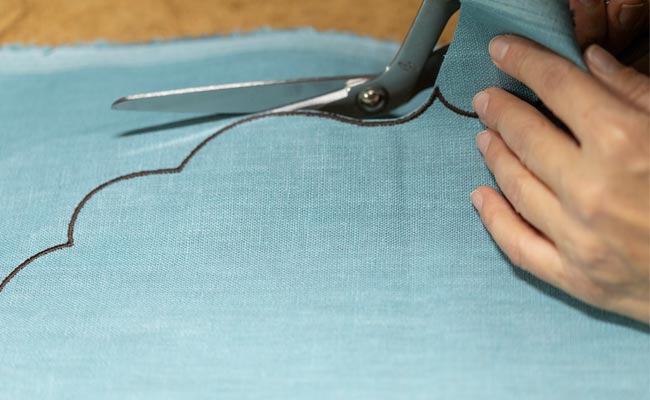
Once executed, the embroidery is then hand-finished. This is where the full artisanal expertise of La Gallina Matta emerges: the scissors that clean the threads, the hands that lighten the drawing, the needle that adds a stitch where needed, the final check, the flame that removes the last residues. Every gesture contributes to giving the product an impeccable finish and an authentic presence.
The precision of handwork
No product is truly finished without the work of the hands. Coasters, placemats, napkins, tablecloths: each piece is finished with the same attention, because final quality is born from the meeting of design, technique and manual care. It’s here that the collection acquires its truest identity.

The harmony of the LGM collection
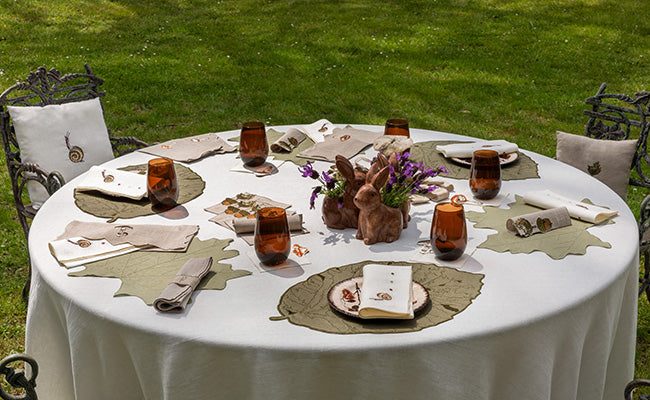
But the work doesn’t end with the single product. Every element must then converse with the others, because an LGM collection is never the sum of isolated pieces, but a harmonious system of colors, contrasts, materials and atmospheres. For this reason, you start playing with pairings again, observing fabrics next to plates, surfaces, household objects—imagining rooms and tables where the product can truly live.
This phase of composition is as fundamental as the previous ones, because it helps you understand whether the product works not only in itself, but in the world it builds around itself. It’s a final focusing step where even the iron, in the seamstresses’ hands, becomes a tool of perfection.
To tell this vision, the LGM site places not only the individual pieces at its center, but also their context: Table Linens, Collections, and above all Our Tables, where every product finds its most natural dimension within a story made of colors, materials and pairings.

A collection that becomes a story
At the end of this journey, what’s born is not just an object, but a story. An LGM collection is the result of a long, complex and deeply shared process in which Claudia’s initial idea passes through drawing, color, sample, atelier, finishing and final composition.
It’s work that unites creativity and technique, intuition and precision, vision and craft. And it’s precisely in this balance that La Gallina Matta’s identity is recognized: in the ability to transform an inspiration into a concrete presence—beautiful to see, pleasant to use, and able to inhabit the table with grace.
Leave a comment
This site is protected by hCaptcha and the hCaptcha Privacy Policy and Terms of Service apply.